
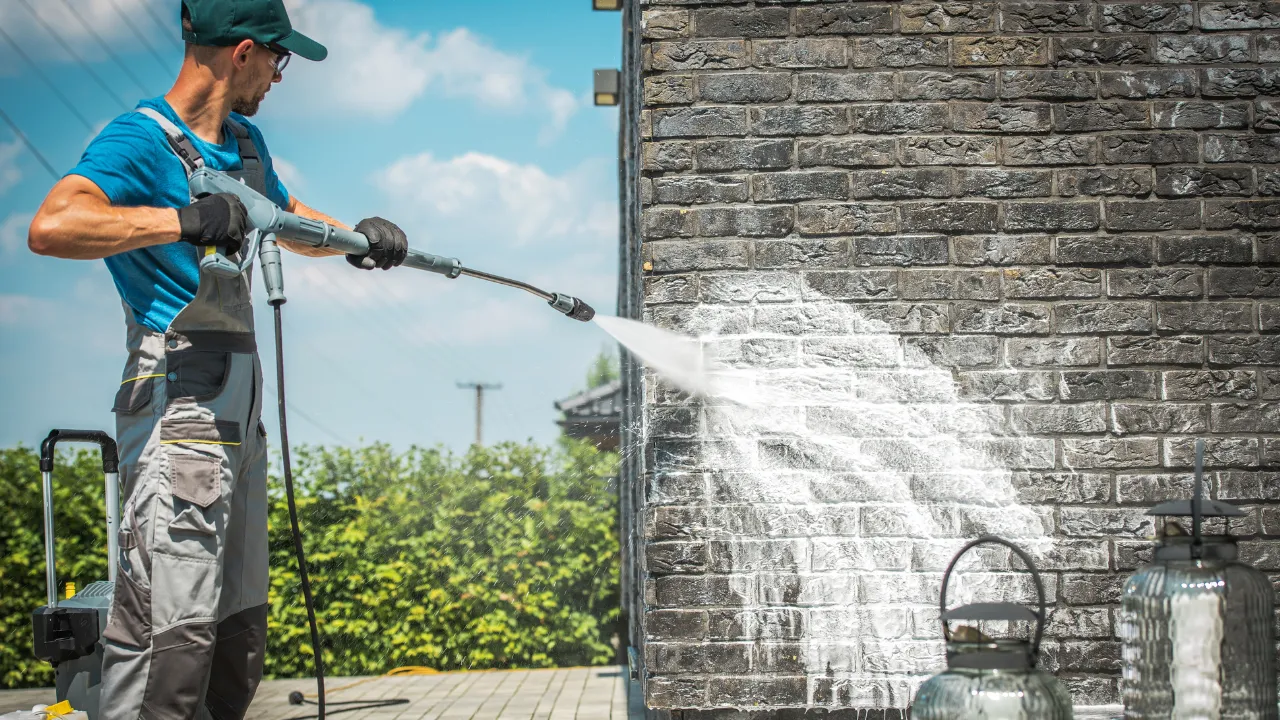
Soft Wash vs Pressure Wash: What Does Your Stucco Actually Need?
Short answer: stucco almost always needs a soft wash, not a pressure wash. Soft washing cleans at roughly 100 to 500 PSI and relies on a detergent to do the work. Pressure washing drives water at 1,500 to 4,000 PSI and relies on force. On a hard surface like concrete, force is fine. On stucco, force is what cracks the finish, opens hairline gaps, and drives water behind the wall. The two methods look similar from the curb, but they are not interchangeable, and choosing wrong on a stucco home or commercial building is an expensive mistake.
Across the Coachella Valley, most homes and a large share of commercial buildings are clad in stucco. It is the right material for the desert, but it is porous, brittle at the surface, and unforgiving of high pressure. Below is how the two methods differ, why pressure damages stucco, and how a professional decides which surface gets which approach.
Key Takeaways
- Soft wash runs at about 100 to 500 PSI plus a cleaning solution. It is the correct method for stucco, painted surfaces, and anything that grows algae or mildew.
- Pressure wash runs at 1,500 to 4,000 PSI on raw force. It belongs on concrete, pavers, block, and other hard, non-porous surfaces.
- High pressure on stucco chips the finish coat, opens cracks, and pushes moisture behind the wall where it causes lasting damage.
- Soft washing kills algae and mold at the root with a surfactant-carried solution, so the surface stays clean longer than a blasted one.
- When in doubt, the surface decides the method. A pro reads the substrate before touching a trigger.
What soft washing actually is
Soft washing is low-pressure cleaning that does the work chemically instead of mechanically. Output pressure sits in the range of a garden hose, roughly 100 to 500 PSI, far below the 1,500 PSI floor where pressure washing begins. The cleaning happens through a measured solution, usually a sodium hypochlorite base blended with a surfactant. The surfactant is the key ingredient: it lets the solution cling to vertical stucco instead of sheeting straight off, dwell long enough to break down organic growth, and rinse clean without scrubbing.
That distinction matters because most of what discolors stucco is biological. Algae, mildew, mold, and lichen are living growth. High pressure knocks the visible layer off the surface, but the roots stay embedded in the pores and regrow within weeks. A soft-wash solution kills the organism at the root, which is why a properly soft-washed wall stays clean for one to three years instead of one to three months.
What pressure washing is built for
Pressure washing is the opposite tool. It uses a narrow, high-velocity stream, commonly 1,500 to 4,000 PSI, to physically blast dirt, mineral scale, and grime off hard surfaces. There is no chemistry doing the heavy lifting; the water pressure is the mechanism. That is exactly what you want on concrete driveways, paver patios, pool decks, block retaining walls, and loading docks, where the substrate is dense enough to take the hit and the goal is to lift embedded grime out of a rough surface.
The problem is that the same force that strips a driveway will carve into softer materials. Pressure does not know the difference between a concrete slab and a stucco wall. The operator does, or should.
Why high pressure damages stucco
Stucco is a thin cement plaster troweled over lath in coats, finished with a textured top layer that is only a fraction of an inch thick. That finish coat is the part that fails first under pressure. Here is what high PSI does to it:
- It chips and gouges the finish. A 3,000 PSI tip held too close blows out the texture and leaves bare, lighter patches that never blend back in.
- It opens hairline cracks. Desert stucco already micro-cracks from heat cycling. High pressure widens those cracks and creates new ones along stress lines.
- It forces water behind the wall. Once pressure pushes moisture through a crack or a gap around a window, it sits in the wall cavity. In the desert that means trapped damp, staining that bleeds back through, and eventually substrate failure.
- It strips paint and sealant. Elastomeric coatings and paint that protect stucco come off in sheets under a pressure tip, leaving the wall less protected than before it was cleaned.
None of this is visible the second it happens. The damage shows up weeks later as flaking, efflorescence bleeding through, or a stain that keeps returning no matter how often the wall is cleaned. By then the cause is hard to trace and expensive to fix.
Which surfaces get which method
The rule professionals follow is simple: porous and painted surfaces get soft washed, dense and unfinished surfaces get pressure washed. Here is how that plays out on a typical Coachella Valley property:
- Soft wash: stucco walls and parapets, painted block, EIFS, wood and composite fascia, screen enclosures, awnings, roof tiles, and any surface carrying algae or mildew.
- Pressure wash: concrete driveways, sidewalks, paver patios, pool decks, unpainted block walls, loading docks, and dumpster pads.
Most jobs are a mix. A single house can need a soft wash on the stucco and a pressure wash on the driveway in the same visit. The skill is switching methods surface by surface rather than treating the whole property with one setting. That is the difference between our pressure washing service and a one-machine operator who runs everything at full force.
How a pro decides on site
Before anyone pulls a trigger, the surface gets read. We check the substrate (stucco, concrete, block, painted or raw), the finish (is there paint or sealant to protect), the soiling (organic growth versus mineral scale versus oil), and the condition (existing cracks, prior damage, loose finish). Stucco and painted surfaces route to a soft wash with the right solution mix and dwell time. Hard, unfinished surfaces route to pressure, with the PSI and tip dialed to the material. For mixed commercial sites, our commercial pressure washing and power cleaning crews carry both setups on the same truck, so the building envelope gets soft washed while the parking area gets pressure cleaned in one mobilization.
Bright, streak-free glass is part of the same job. When we soft wash a storefront or a home exterior, our window cleaning finishes the elevation so the whole building reads clean, not just the walls.
The DIY line
If you own a consumer pressure washer and want to rinse a concrete driveway, that is reasonable weekend work. Where homeowners get into trouble is aiming that same machine at stucco. Even a small electric unit produces enough pressure to chip a finish coat if held close, and no consumer machine injects a proper soft-wash solution at the right ratio. The growth comes back, and now there is finish damage on top of it. For any stucco, painted, or elevated surface, the cost of doing it wrong is higher than the cost of having it done right.
Soft Wash vs Pressure Wash FAQs
Will pressure washing ruin my stucco?+
What PSI is safe for stucco?+
Does soft washing keep the wall clean longer?+
Can you soft wash the house and pressure wash the driveway in one visit?+
Stucco That Needs Cleaning, Done the Right Way
We read the surface before we touch a trigger: soft wash for stucco, pressure for concrete. Send your address and we respond within 24 hours with a flat-rate quote.