
How to Remove Efflorescence and Oil Stains From Concrete
Efflorescence and oil are the two stains that survive a normal driveway cleaning, and they survive for opposite reasons. Efflorescence is a mineral salt that water alone reactivates, so rinsing it just moves it around. Oil is petroleum that sits in the pores below the surface, so blasting the top does nothing to the stain underneath. Both need the right chemistry and, for oil, the right heat. Here is what each one is, how professionals remove them, and where do-it-yourself methods hit their limit.
Key Takeaways
- Efflorescence is a white, powdery deposit of mineral salts pushed to the surface by moisture. It is not mold or dirt and will not rinse off with water.
- Removing efflorescence takes a mild acid treatment, such as an F9 BARC product, that dissolves the salts so they can be rinsed away rather than redeposited.
- Oil and grease sit in the pores of the concrete. They need a degreaser plus hot water up to 250F to break the bond and lift the petroleum out.
- Cold water and a box-store machine will not pull oil. Heat is the variable most homeowners are missing.
- Fresh stains clean up nearly completely; old stains baked into porous concrete improve a great deal but may not vanish.
What efflorescence actually is
Efflorescence is the chalky white film that shows up on concrete, pavers, block, and stucco, usually after the surface has been wet. It is not a stain sitting on top and it is not biological growth. It is mineral salt that was always inside the concrete. When moisture moves through the slab, it dissolves those salts, carries them to the surface, and evaporates, leaving the salt behind as a crust. That is why it often appears worse after rain or irrigation, and why scrubbing with water makes it spread: water is the carrier that brought it up in the first place.
Because the cause is mineral, the fix has to be chemical. A mild acid treatment dissolves the salt deposit so it can be rinsed off cleanly instead of redeposited as the surface dries. Products in the F9 line, particularly F9 BARC (Barrier Anti-Redeposit Cleaner), are formulated for exactly this. The acid converts the salts, the surfactant holds them in suspension, and a thorough rinse carries them away. Done right, the white haze is gone and stays gone, as long as the underlying moisture source is managed.
How professionals remove efflorescence
The process is methodical, not aggressive. Pressure is secondary here; the chemistry does the work:
- Pre-rinse and contain. Wet adjacent plants and surfaces so the acid treatment cannot etch or burn anything it is not meant to touch.
- Apply the treatment. An F9 BARC-type acidic cleaner goes down at the right dilution and is given dwell time to react with the salts. No guessing on ratio; too strong etches the concrete, too weak leaves haze.
- Agitate if needed. Heavy deposits get light agitation to open the crust so the cleaner reaches all of it.
- Rinse thoroughly. A complete rinse is what separates removal from redeposit. Leftover dissolved salt that dries on the surface just becomes new efflorescence.
- Neutralize. The treated area is neutralized so no active acid remains on the concrete.
This is the kind of surface-specific work our pressure washing service handles as a matter of course, rather than running one pressure setting over everything and hoping the white film comes up.
What oil stains are and why they resist
Concrete looks solid but it is porous, full of tiny capillaries. When motor oil, transmission fluid, or grease lands on it, the petroleum wicks down into those pores and bonds to the concrete below the surface. That is why a pressure washer alone fails on oil: it cleans the top layer while the stain lives underneath. You can blast an oil spot at 3,500 PSI all day and watch the dark shadow stay exactly where it was.
Removing oil takes two things working together: a degreaser to break the chemical bond, and heat to thin the petroleum so it releases from the pores. This is where hot water earns its place. Heated water, up to 250F in a commercial unit, does to grease what hot water does to a greasy pan that cold water just smears. The combination of degreaser and heat lifts the oil out of the concrete instead of pushing it deeper.
How professionals degrease oil-stained concrete
- Apply a commercial degreaser. The surface is treated with an alkaline degreaser and given time to penetrate and emulsify the oil.
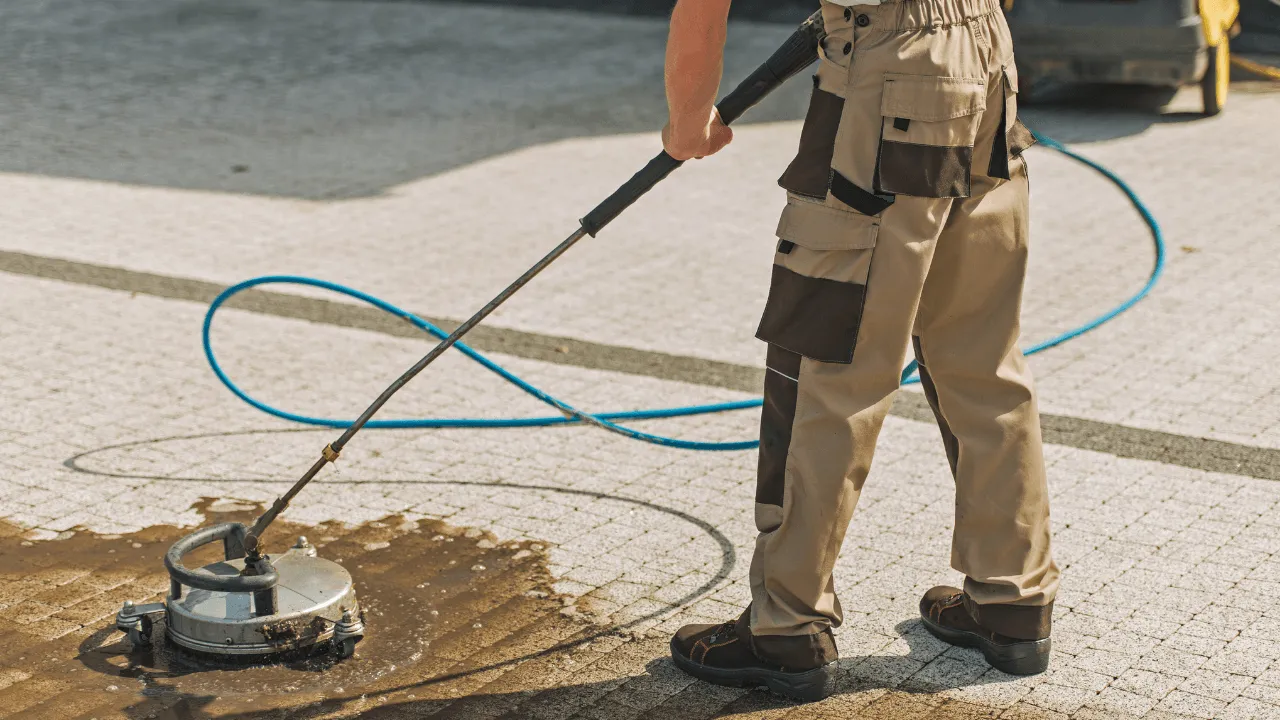
- Hit it with hot water. Hot-water pressure cleaning at the right temperature and PSI breaks the bond and floats the petroleum to the surface. This is the core of our power cleaning work.
- Lift and repeat. Deep or old stains often take a second pass. Each cycle pulls more petroleum out of the pores.
- Set realistic expectations. A fresh spill comes up to nearly clean. A stain that has been soaking into porous concrete for years lightens dramatically but may leave a faint ghost. We say so before booking rather than after.
Driveways, pads, and commercial floors
The same two problems scale up across the properties we clean in the Coachella Valley and Inland Empire. Residential driveways collect oil drips and efflorescence along the slab edges. HOA and commercial parking areas accumulate years of fleet leaks. Loading docks, fuel islands, and equipment pads are petroleum from end to end. For those larger jobs, our commercial pressure washing crews bring hot-water units and degreasers sized for the surface, and price the work flat-rate so a property manager knows the number before the truck rolls.
Where DIY hits its limit
You can make real progress on a small, fresh oil spot with cat litter to absorb the surface oil, a stiff brush, and a degreaser. Light efflorescence on a paver path may respond to a vinegar solution and patient rinsing. The DIY ceiling shows up in three places: you do not have hot water, so deep oil will not release; you do not have the correct acidic cleaner or the experience to dilute it without etching the concrete; and you do not have the volume of clean rinse water that keeps dissolved salt from redepositing. When the stain is large, old, on a visible surface, or you have tried once and it came back, that is the line where professional treatment is worth it.
Efflorescence & Oil Stain FAQs
Why does the white film on my concrete keep coming back?+
Can a pressure washer remove oil stains from concrete?+
Will old oil stains come out completely?+
Is efflorescence the same as mold?+
Stained Concrete That Will Not Come Clean?
We bring the degreasers, the F9 treatments, and hot water up to 250F for oil and efflorescence across the Coachella Valley and Inland Empire. Send your address for a flat-rate quote within 24 hours.